

August Priske — Scouting Report

TL;DR
August Priske is a pure box striker.
His value is almost entirely in finishing moves, not building them.2025 is his first true breakout season (19 goals).
The output is real, but sustainability across leagues remains the key risk.Shot profile is strong and repeatable.
High volume from central penalty-area zones, minimal low-value shooting.Well-rounded finisher.
Even split of right foot, left foot, and headed goals suggests adaptability inside the box.Very limited outside-the-box contribution.
He does not create, connect, or progress play — he depends on service.Best suited to possession-dominant teams.
His impact drops in low-possession or transition-heavy matches.Priske doesn’t fix Birmingham’s attack — he rewards it.
If Blues increase shots from central penalty-area zones, he directly improves conversion. If not, his influence will be narrow.Squad balance remains unresolved.
Four natural #9s and no true connector behind them increases the need for a natural #8–10.
Bottom line:
Priske is a role-specific finisher with real upside. He fits cleanly into a functioning attacking structure — but he does not replace the missing connective piece that makes that structure work.
1. Player Snapshot
Name: August Priske
Age / DOB: 21 (2004)
Nationality: Denmark
Height / Weight: 6'1" / 165lbs
Preferred foot: Right foot
Primary position: Centre Forward (#9)
Club / League: Djurgården — Allsvenskan
Minutes analysed: ~2,100–2,260

2. Role Definition & Usage
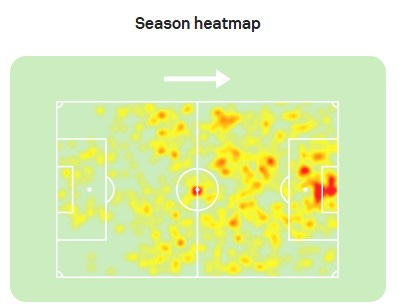
Priske profiles as a penalty-box striker whose primary function is to finish attacks.
He is not heavily involved in build-up play, does not regularly drop into midfield to connect phases, and does not act as a creative reference point. His value is concentrated in the final third, particularly once the ball enters the penalty area.
Most of his attacking contribution comes from:
Central positioning between centre-backs
Timing of runs into the box
Willingness to take responsibility for shots
He is asked to end moves, not run them.
3. Scoring Trajectory & Development Context
Priske’s goal output is heavily concentrated in the most recent season.
Across his senior career:
2023: 3 goals, 1 assist
2024: 5 goals, 1 assist
2025: 19 goals, 2 assists
This makes 2025 his first true breakout season.
At 21, this is consistent with a typical striker development curve, where physical maturity, confidence, and role clarity can converge quickly. At the same time, a single breakout season introduces uncertainty around sustainability, particularly when projecting into a stronger league.
The key question is not whether he can score, but whether the conditions that enabled this output can be recreated.
4. Goal Threat & Finishing Profile
Priske generates a high volume of shots from high-value locations, with his output concentrated almost entirely inside the penalty area.
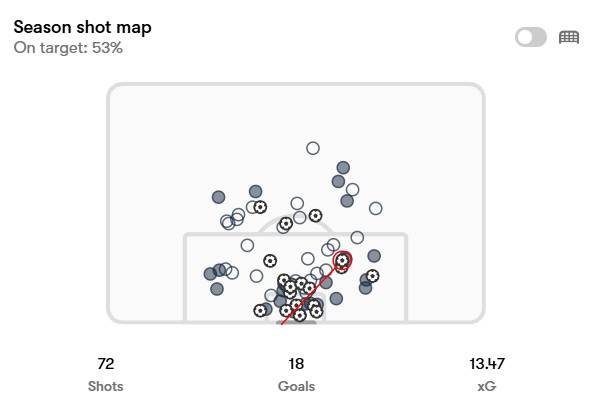
He averages just over three shots per game, with a strong bias toward central penalty-area zones. His shot map shows repeated occupation of the space between the penalty spot and the six-yard box, rather than reliance on speculative efforts from distance. This indicates a striker whose scoring opportunities are driven by movement and positioning, not by low-probability shot selection.
His goal output has exceeded expected levels, suggesting effective finishing execution — whether through placement, composure, or confidence. That overperformance should be treated with some caution, as finishing tends to be volatile across seasons and league transitions.
One encouraging signal within this breakout season is the variety of his finishing methods. Across his 18 league goals, the distribution is evenly split:
6 right-footed
6 left-footed
6 headers
This points to a forward who is functionally two-footed and competent in the air, rather than reliant on a single dominant foot or a narrow finishing pattern. It allows him to convert a broader range of box deliveries — cutbacks, rebounds, and crosses — and reduces the risk of defenders over-playing one side or body shape.
Taken together, Priske profiles as an all-round finisher inside the box, even if his overall contribution remains concentrated in that phase of play. The sustainability of his goal output depends less on shot selection — which is already strong — and more on whether he can continue accessing these central areas against faster, more aggressive defensive units.
In simple terms, Priske is a striker who lives off team dominance rather than individual initiative.
5. Attacking Contribution Beyond Goals
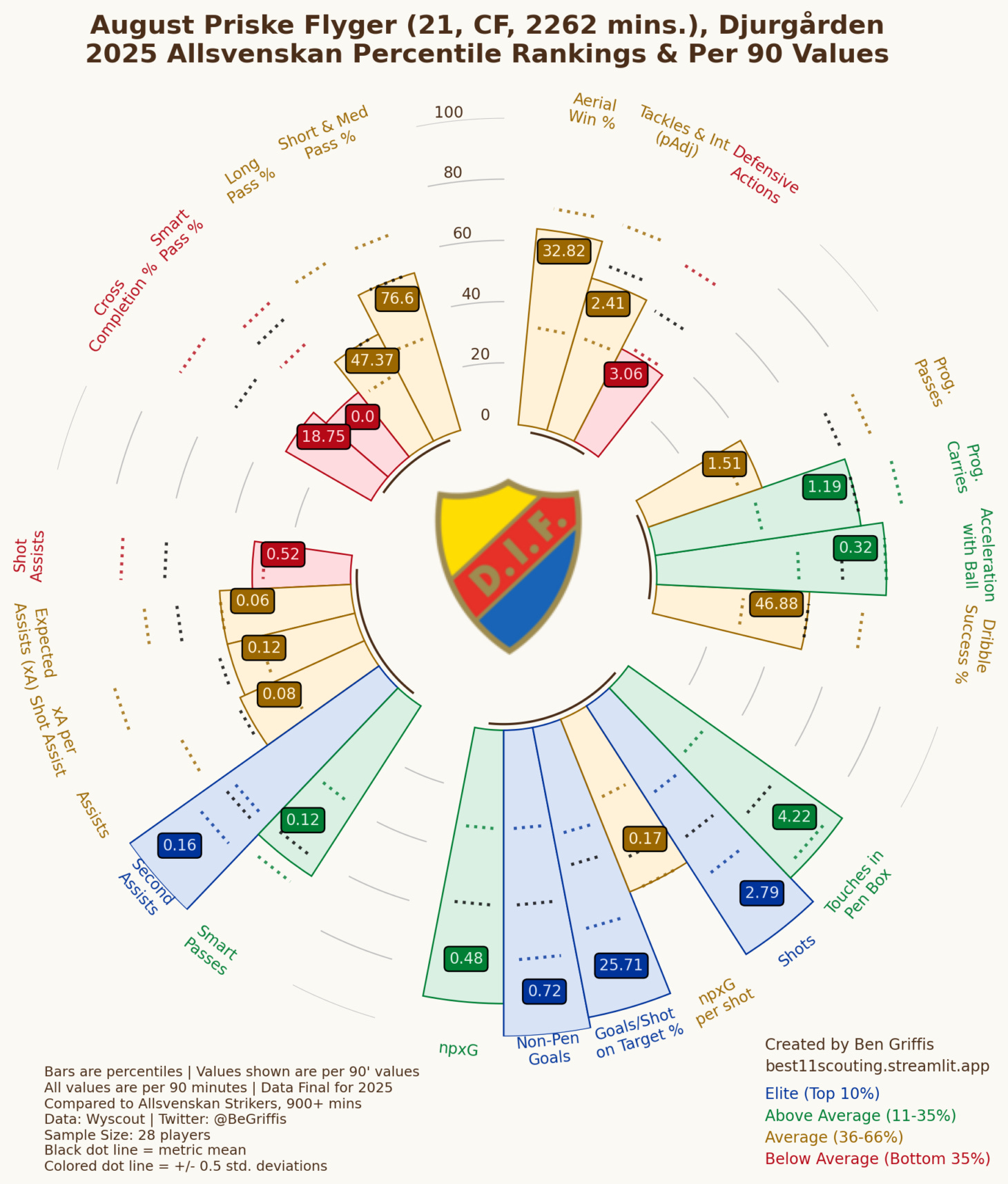
Outside of finishing, Priske’s attacking contribution is limited.
He records low assist output, does not regularly play the final pass, and is not involved in shaping attacking patterns. He does not function as a creator or connector.
His indirect value comes through:
Occupying defenders centrally
Forcing centre-backs to defend deeper
Creating space for runners and second-phase opportunities
If a team struggles to progress the ball or create chances, Priske is unlikely to compensate through individual playmaking.
6. Involvement in Build-Up & Ball Progression
Priske has low overall involvement in possession.
He takes relatively few touches, completes few passes, and does not progress play through carries. When he is involved on the ball, actions tend to be quick and goal-oriented rather than connective.
He is not well suited to roles that require the striker to:
Drop and link play
Act as a pressure-release outlet
Secure long passes under heavy contact
This makes him structurally dependent on teammates who can advance play and deliver into the box. When those conditions aren’t present, his influence can look quieter — not because he stops working, but because his value is concentrated into moments rather than phases.
7. Defensive Contribution
Defensively, Priske is willing but not dominant.
He engages in duels and aerial contests, but does not consistently control them. His interception numbers are low, indicating limited anticipatory defending or space control.
He can function within a pressing structure, but is unlikely to be the forward who defines or drives it. His defensive contribution is supportive rather than value-driving.
8. Birmingham City Context: Volume Is Not the Issue
This season, Birmingham are joint 5th in the league for total shots.
They sit firmly in the upper tier for attacking volume. The issue is not the number of attempts generated, but where those attempts are coming from.
Birmingham create enough shots to compete with promotion-chasing sides, but a smaller share of those attempts arrive from the wider penalty area — the zone that produces the most repeatable goals over a season.
As a result, overall shot volume is not consistently translating into goals.
9. Shot Geography: Where the Margins Are Being Lost
Breaking down Birmingham’s shot locations adds important context:
9th for shots from the penalty area
(7.0 per game — leaders Coventry generate 10.1)4th for shots from the six-yard box
(1.6 per game — leaders Coventry 1.8)6th for shots from outside the box
(5.3 per game — leaders Oxford 6.1)
This profile is instructive.
Birmingham are capable of creating clear, high-quality chances, as reflected by their six-yard-box output. However, they generate fewer shots from the wider penalty area than the league’s leading sides — the zone from which goals are most consistently scored over a season.
Improving chance generation from the wider penalty area offers one of the clearest routes to:
Better conversion
Higher goal output
Tangible movement up the table
10. What Priske Changes — and What He Doesn’t
Priske does not materially improve:
Shot volume
Chance creation
Long-range shot quality
He improves Birmingham significantly if one thing changes:
The share of shots taken from central penalty-area zones must increase.
Priske is unlikely to be the player who creates those chances. He does not drop deep to progress play, does not combine extensively to break lines, and does not drive shot volume through individual actions.
What he does offer is reliable finishing once those situations exist.
If Birmingham can shift more attacks into the penalty area, Priske directly targets a known weakness: conversion inefficiency.
If they cannot, his impact will be narrower and more variable, regardless of individual quality.
Priske doesn’t fix how Birmingham attack — he rewards them when they get it right.
11. Game State & Possession Dependency
Priske’s effectiveness is closely tied to possession and territory.
He is at his best when Birmingham:
Control the ball
Sustain pressure in the final third
Generate repeated box entries
These conditions are more common in:
Home matches
Fixtures against lower or equal opposition
In matches where Birmingham have less possession — often away from home — his influence is likely to drop.
He does not currently profile as a striker who can:
Hold the ball up to relieve pressure
Combine to reset attacks when pinned back
Act as a reliable outlet in low-possession phases
While Priske has the frame to compete physically and can occasionally secure the ball under contact, his profile does not suggest a striker who should be relied upon for sustained hold-up play. His effectiveness is driven by movement and timing rather than repeated back-to-goal involvement, and his usage to date reflects that.
He is a finisher, not a pressure-relief forward.
12. Squad Structure & Likely Line-Up Implications
Priske’s arrival sharpens an existing structural issue rather than creating a new one.
Birmingham now have four players whose natural role is as a central #9: Ducksh, Stansfield, Kyogo, and Priske. All four are most effective when attacks are oriented toward the penalty area and when their responsibilities are clearly defined.
In recent usage, both Ducksh and Stansfield have been trialled as nominal #10s. While understandable as a short-term solution, this has largely been a compromise rather than a strength. Neither profiles as a natural conductor of play between the lines, and the result has often been reduced fluency and slower progression into the final third.
Priske’s profile does not resolve this. He does not operate as a second striker, does not drop into midfield to link play, and does not meaningfully reduce the need for a true connective presence behind the forward line. If anything, his arrival increases the importance of that role.
From a squad-balance perspective, it is difficult to justify carrying four central strikers competing for a single position. If Priske is viewed as a medium-term option with upside, his presence may implicitly narrow the pathway for Kyogo.
The broader implication is clear:
to get the best out of Birmingham’s attacking group, a natural #8-10 is required (I sound like a broken record, I know).
A player capable of:
Receiving between the lines
Sustaining possession under pressure
Connecting wide play, central runners, and the striker
Without that presence, Birmingham are likely to continue relying on makeshift solutions — asking strikers to perform connective roles they are not suited to — which risks dragging down overall attacking coherence and fluidity.
Priske fits cleanly into a system that already works.
He does not solve the absence of the piece that makes that system function.
13. Development Perspective (Age-Related Upside)
At 21, Priske should be viewed as a developing profile rather than a finished product.
Many of the limitations identified are common for young strikers whose early success is driven by finishing rather than all-phase involvement. With targeted coaching, there is credible scope for improvement.
14. Priority Development Areas
The following areas represent realistic and high-impact development focuses:
Functional hold-up play:
Improving first contact, ball protection for short spells, and simple lay-offs to support low-possession phases.Receiving under pressure:
Better body orientation and decision-making when marked tightly to sustain attacks.Variation in box movement:
More delayed arrivals and double movements to reduce predictability as defensive attention increases.Pressing structure awareness:
Improved angles and lane blocking to raise defensive value without increasing workload.Simple combination play around the box:
One- and two-touch combinations to prevent attacks breaking down early.
15. Recruitment Status Summary
Profile type
Box-focused finisher with narrow but clearly defined strengths.
Best-use environment
Teams that dominate possession and generate regular penalty-area entries.
Primary risks
Sustainability of first breakout season
Limited contribution outside finishing
Reduced impact in low-possession matches
Key conditions for success
Increased volume of penalty-area shots
Reliable service into central zones
Acceptance of a role-specific striker profile