

Two MLS Creators, Two Very Different Translation Bets

MLS continues to produce technically strong creators, but translating that output to the Championship is less about raw numbers and more about how those numbers are generated.
With Birmingham recently linked to a wide player from MLS, it felt like a useful moment to step back and take a broader look at the type of profiles the MLS is producing — rather than focusing on any one rumour. That prompted a deeper dive into MLS attackers who grade highly in my attacking models and illustrate very different pathways to creative value.
Ali Ahmed and Jack McGlynn both surface strongly on the data. On the surface, their output looks similar — but they arrive there from very different starting points: one primarily from wide, touchline-led involvement, the other through central connectivity and control.
This isn’t a straight comparison between players, nor a commentary on any specific link. It’s a study in role versus function, and what that distinction tells us about translating MLS production into the EFL.

Ali Ahmed — Scouting Report
Vancouver Whitecaps | MLS
Minutes analysed: ~1,650
Age: 25
Preferred foot: Left

1. Player Snapshot
Name: Ali Ahmed
Date of Birth / Age: 2000 (25)
Preferred Foot: Right
Primary Positions:
– Wide midfielder
– Wide forward
Secondary Positions:
– Inverted wide attacker
– Attacking midfielder (situational)
Club / League: Vancouver Whitecaps — MLS
International Experience: Canada (senior)
Broad Market Context:
Mid-range fee likely. Senior international status increases visibility and competition.
2. Role Definition & Usage
Primary Role
Ball-dominant wide creator–carrier operating from high and wide starting positions, tasked with advancing play and generating chances through individual progression.
Typical Involvement
Receives early and frequently in wide zones
Drives play from the flank into half-spaces
Heavy involvement across attacking sequences
Participates in build-up more than most wide forwards
Usage Profile
Granted licence to roam and carry
Progression responsibility sits with the player rather than structure
Output driven by touch volume and freedom
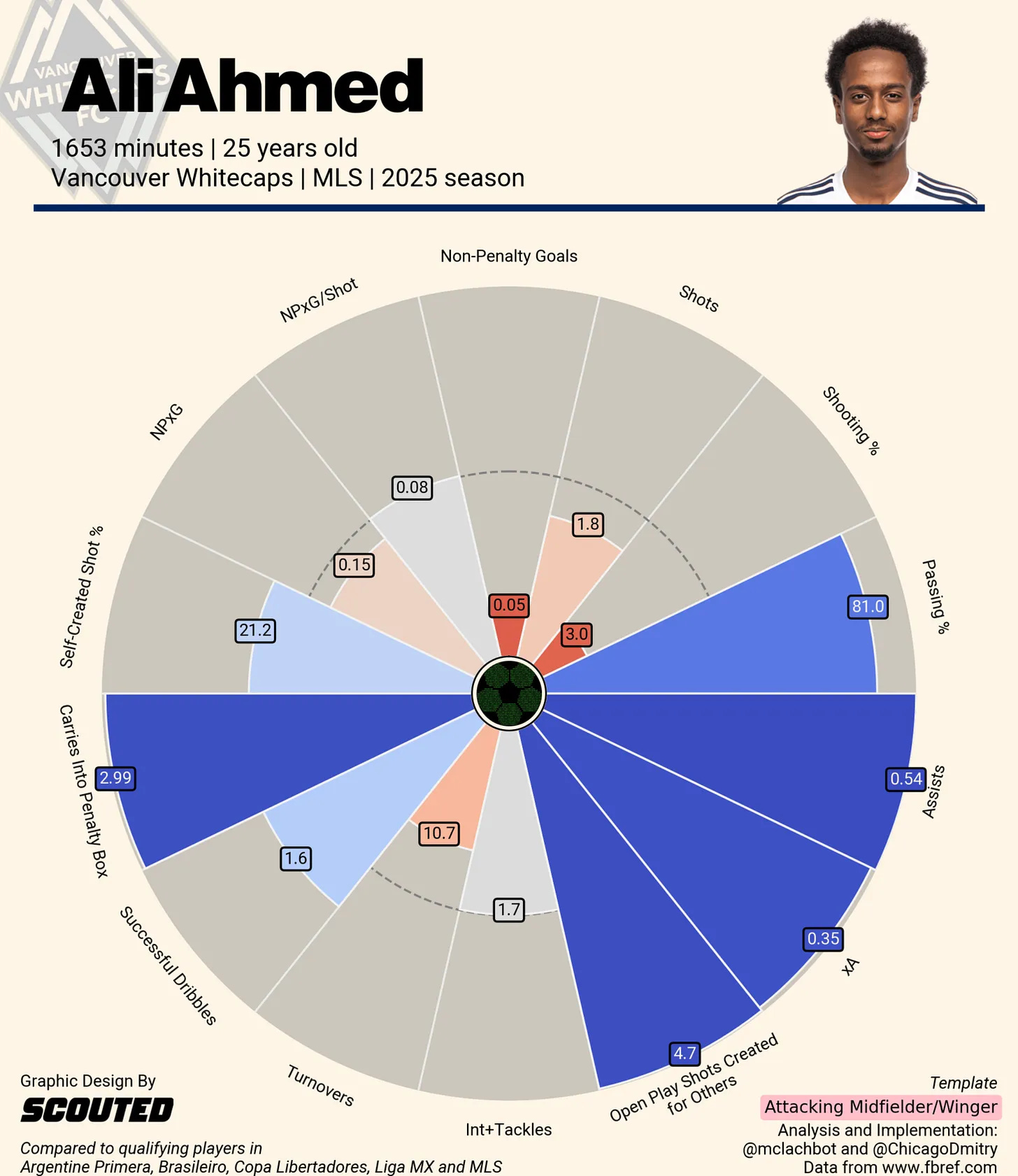
His influence is anchored to wide starting positions, with effectiveness tied to repeated flank involvement rather than central control.
3. Data Interpretation
Output Generation
xA: Elite relative to MLS wide forwards
Shot-creating actions: Very high
Progressive carries & carry distance: Extremely high
Radar data shows output clustering around progression and creation, not finishing.
Volume vs Efficiency
Production driven by repeated involvement rather than selectivity
Passing and creative metrics scale with touches
Risk Appetite in Possession
Willing to carry into traffic and attempt difficult final actions
Turnover rate reflects role intent rather than poor decision-making
Stability vs Volatility
Output is role-sensitive
Production compresses if roaming licence or touch volume is reduced
More volatile than possession-first creators
Ahmed’s output is driven by volume of actions rather than efficiency under reduced involvement.
4. Strengths & Trade-Offs
Strengths
Direct ball progression from wide areas
Comfortable receiving under pressure
Maintains attacking tempo through repetition
Can independently move attacks forward
Trade-Offs
Output dependent on role freedom
Ball security is average relative to involvement
Limited aerial and physical presence
Defensive contribution is functional, not value-driving
These are intentional trade-offs, not execution errors.
5. Tactical Fit
Systems Where Value Is Maximised
Possession-leaning sides using wide wingers/forwards and inverted wide attackers
Structures where wide players are primary progressors
Structural Dependencies
Requires midfield stability behind him
Benefits from overlapping or underlapping full-back support to sustain wide carries and repeated involvement.
Contexts Where Effectiveness May Drop
Direct, low-touch systems
Roles restricting roaming or progression responsibility
6. Risk & Translation Flags
Championship translation depends on sustained licence to roam
Physicality and contact tolerance require validation
Ball security under reduced space is an open question
7. Market & Feasibility Context
Likely fee: ~£2.0m–£3.5m
Senior international status raises competition
Higher-variance profile with higher immediate impact potential
8. Recruitment Status Summary
Profile Suitability:
High-volume wide creator / carrier
Readiness Level:
Capable of immediate contribution in possession-dominant systems
Key Risks to Resolve:
Role dependency
Physical translation
Output compression under constrained usage
Recommended Next Steps:
Live scouting in low-possession matches
Physical robustness profiling
Tactical review under reduced touches

Jack McGlynn — Scouting Report
Houston Dynamo | MLS
Minutes analysed: ~1,780
Age: 22
Preferred foot: Left
1. Player Snapshot
Name: Jack McGlynn
Date of Birth / Age: 2003 (22)
Preferred Foot: Left
Primary Position:
– Inverted Wide Forward/Wing
Secondary Projections:
– Attacking midfielder
– 8 / 10
Club / League: Houston Dynamo — MLS
International Experience: USA youth; senior involvement
Registration Status: Irish passport
Broad Market Context:
Development-age transfer. System-dependent valuation.
2. Role Definition & Usage
Primary Role
Possession-first interiors midfielder operating between lines as a Connector-led creator, with strong Facilitator tendencies.
McGlynn’s value is derived from pass-led progression, tempo control, and chance creation, rather than ball-carrying or physical dominance.
Typical Involvement
Receives in pockets between midfield and defensive lines
Accelerates circulation through early, well-timed passing
Links buildup to final-third action without occupying wide zones
Prioritises access to runners and advanced creators
Usage Profile
Output driven by decision-making, spacing, and timing
Creates threat via passing lanes rather than isolation
Comfortable overlapping functionally with wide creators without drifting wide
Low reliance on dribbling or repeated touches
Functional interpretation:
Unlike volume-driven wide creators, his value translates across both central and wide-adjacent roles because it is not tied to touch frequency or flank isolation.
Connector Profile — Primary
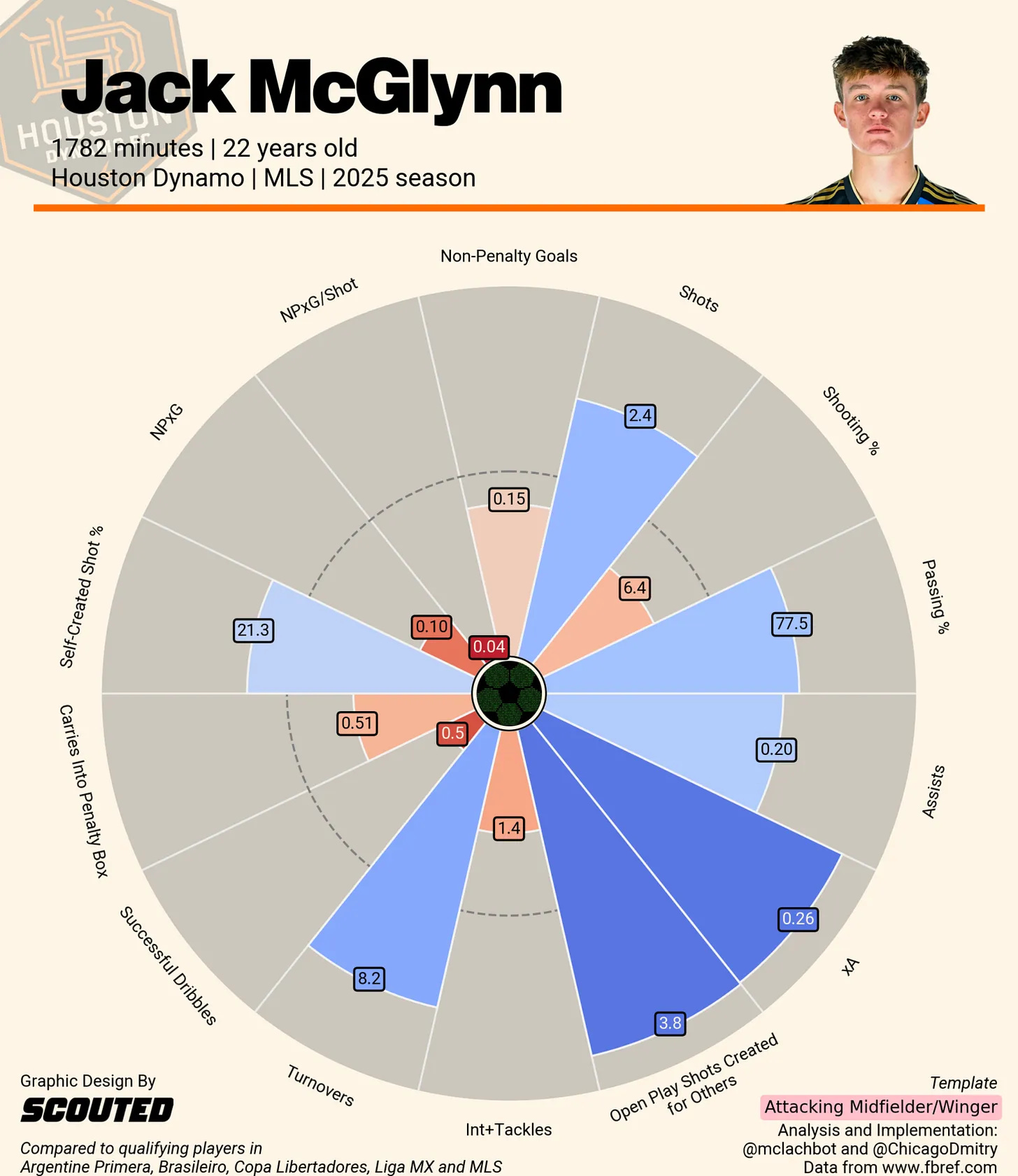
McGlynn scores very highly as a Connector, reflecting his role as a pass-first creative link between phases.
What this indicates in practice:
High involvement in shot creation through passing
Consistent access to dangerous zones without dominating touches
Strong alignment with positional-play structures
Key indicators (relative to role peers):
Expected assists: elite
Shot-creating actions: high
Progressive passing: clear strength
Low dispossession rates despite forward intent
This profile captures creative influence, not volume or ball dominance — which aligns closely with his observed usage.
Facilitator / Tempo-Setter — Secondary
McGlynn also grades very well as a Facilitator, reinforcing that his creative output does not come at the expense of control.
What this adds to the profile:
Maintains rhythm and structure in sustained possession
Reduces volatility rather than increasing it
Preserves attacking value even with reduced involvement
Indicators supporting this:
Strong pass completion under pressure
Low miscontrol and turnover rates
Consistent contribution across game states
Defensive value expressed through positioning, not duels
This dual scoring (Connector + Facilitator) suggests a player who creates without destabilising structure — a less common combination.
Volume vs Efficiency
Produces output with fewer, higher-quality actions
Not reliant on repetition or game-state inflation
He creates chances without needing lots of touches or favourable game conditions.
Risk Appetite in Possession
Selective, measured risk-taking
Prioritises quality over volume
Turnover profile reflects judgement, not passivity
Stability vs Volatility
Lower variance than many advanced creators
Less sensitive to tempo swings
Output resilient to tactical constraints
4. Strengths & Trade-Offs
Strengths
High-quality chance creation via passing
Connector-led creativity with Facilitator-level control
Strong decision-making in tight spaces
Retains value in possession-heavy systems
Set-piece and long-shot threat
Trade-Offs
Limited defensive and duel output
Physically light profile
Not suited to transition-heavy or pressing-led roles
Value diminishes if forced into ball-carrying responsibility
5. Tactical Fit
Systems Where Value Is Maximised
Possession-dominant teams prioritising control
Structured positional-play environments
Midfields with runners ahead of him
Attacks where width is provided by full-backs
Structural Dependencies
Requires physical protection nearby
Defensive burden must be absorbed by others
Most effective when allowed to remain connected, not isolated
Contexts Where Effectiveness May Drop
High-tempo pressing systems
Roles demanding ball-carrying progression
Midfields requiring duel or recovery volume
6. Risk & Translation Flags
Championship physicality remains untested
Broad positional usability across central areas, but functionally specialised toward pass-led, possession-first roles
Unlikely to become a high-impact defender; defensive value comes from maintaining structure rather than winning duels
Requires tactical discipline to extract value
7. Market & Feasibility Context
Estimated fee: ~£5.0m
Irish passport reduces registration friction
Less volatile than many creators, but best used in specific setups.
Best suited to clubs with a clear possession identity
8. Recruitment Status Summary
Profile Suitability:
Connector-led creator with Facilitator-level control and wide-adjacent attacking output
Readiness Level:
Rotational starter or specialist option in control-oriented systems
Key Risks to Resolve:
Physical robustness
Defensive coverage requirements
Role specificity
Recommended Next Steps:
Live scouting in high-tempo matches
Physical resilience testing
Tactical deployment modelling within possession-heavy structures
Conclusion
Ultimately, this isn’t a question of quality, but of translation.
Where Ahmed’s output is maximised by freedom, width, and repetition, McGlynn’s value persists under constraint — driven by timing, positioning, and pass selection rather than touch volume.
Those differences don’t just shape how they play; they shape the type of bet a Championship club is making.